
A dark purple, foggy gradient background with a small glowing lantern in the upper right casting a warm beam over two illuminated labels, “Save” and “Borrow,” while a faint “Spend” label sits in the shadows to the left.

Play the infinite game.

7 MINUTES READ

Dec 1, 2025

Step into my digital universe

Jeff P.
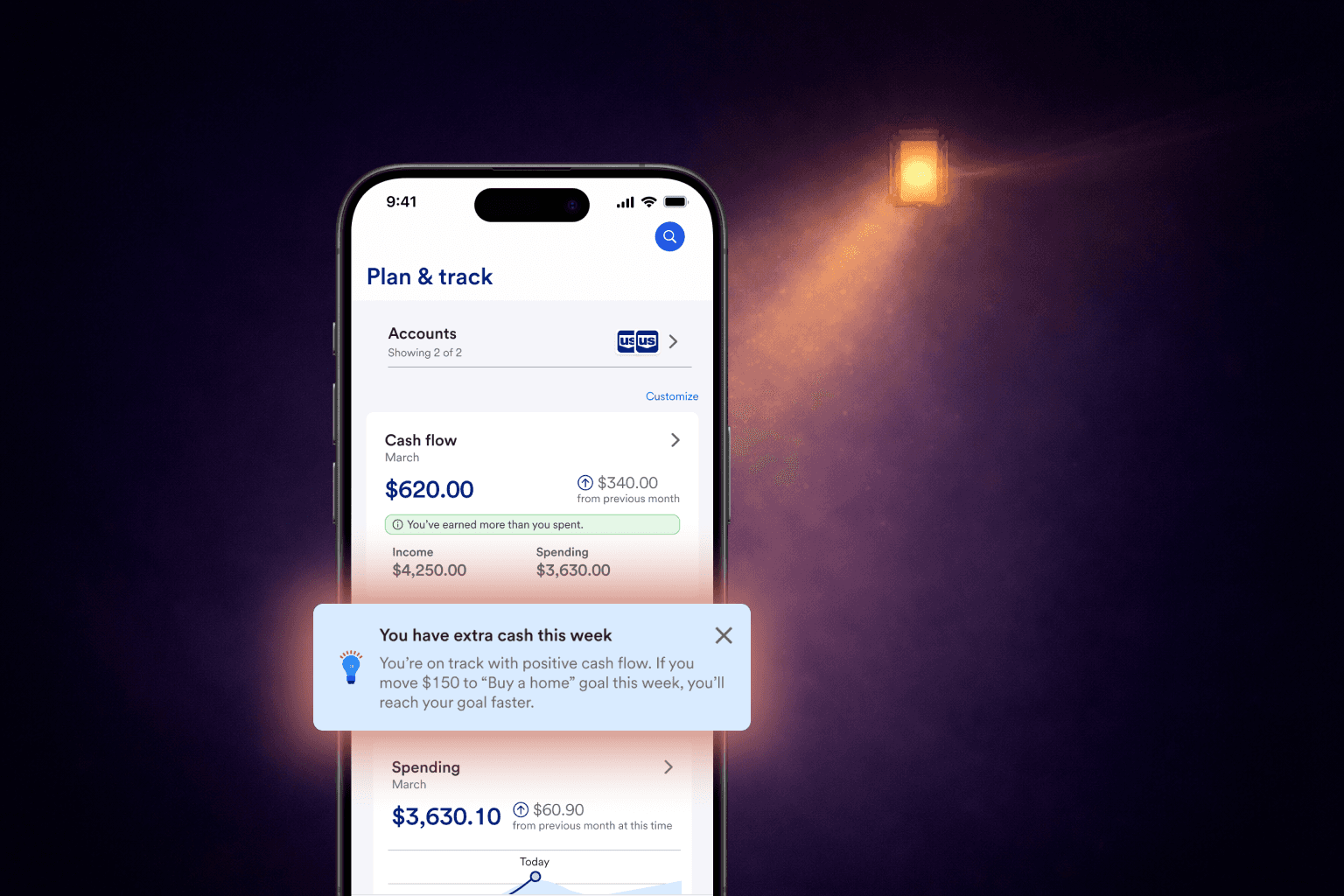
An iPhone mockup showing the “Plan & track” dashboard with cash flow ($620) and spending details, overlaid by a recommendation card that says “You have extra cash this week” and suggests moving $150 toward a “Buy a home” goal, set on a dark purple gradient background with a glowing lantern casting warm light from the upper right.

Client

U.S. Bank

Date

January 1, 2024

Role

UX Lead

Helping users make confident financial decisions through personalization

As the UX Lead for U.S. Bank’s Plan & Track team, I led the discovery and design effort to unify spending, saving, and borrowing tools into one cohesive, personalized experience.

The goal was to help users connect daily actions to long-term goals — and feel more confident managing their finances.

This work began with discovery in Q1 2024 and evolved into a scalable personalization foundation now shaping the 2025–2026 roadmap.

Aligning multiple teams around a shared financial wellness vision

Plan & Track is a cross-functional initiative spanning Product, Design, and Development. I partnered with the Spending, Savings, Borrowing, and Financial Education teams to align tools, journeys, and content into a unified experience.
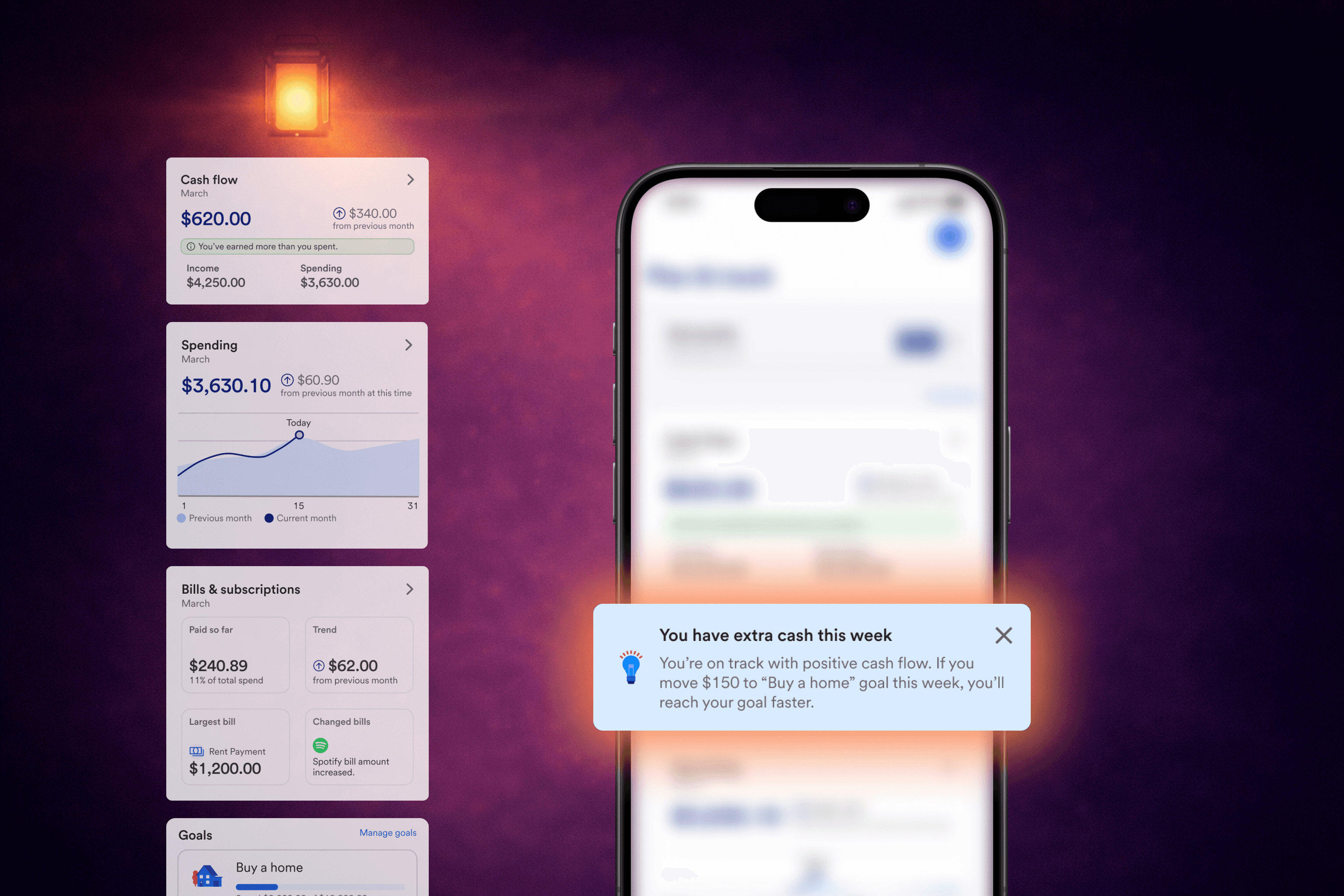
A purple, foggy background lit by a warm lantern at the top left, with floating dashboard cards on the left (cash flow, spending chart, bills & subscriptions, and a “Buy a home” goal) and a large blurred iPhone screen on the right overlaid by a recommendation banner reading “You have extra cash this week,” suggesting moving $150 toward the home goal.

Leading discovery and design across research, strategy, and execution

As UX Lead, I owned the discovery and design process by:

  • Scoping multi-round research with UX Research

  • Leading journey mapping for Young Affluent and Midlife Affluent segments

  • Driving design direction with a UX and Content Designer

  • Defining UX requirements and experience roadmaps

  • Coordinating closely with Development partners

Users needed more than tools — they needed guidance

Financial tools were scattered across the platform, making it hard to see how short-term actions supported long-term goals.

Research showed users wanted a personalized, contextual experience — one that adapted to life stage, confidence level, and financial intent.
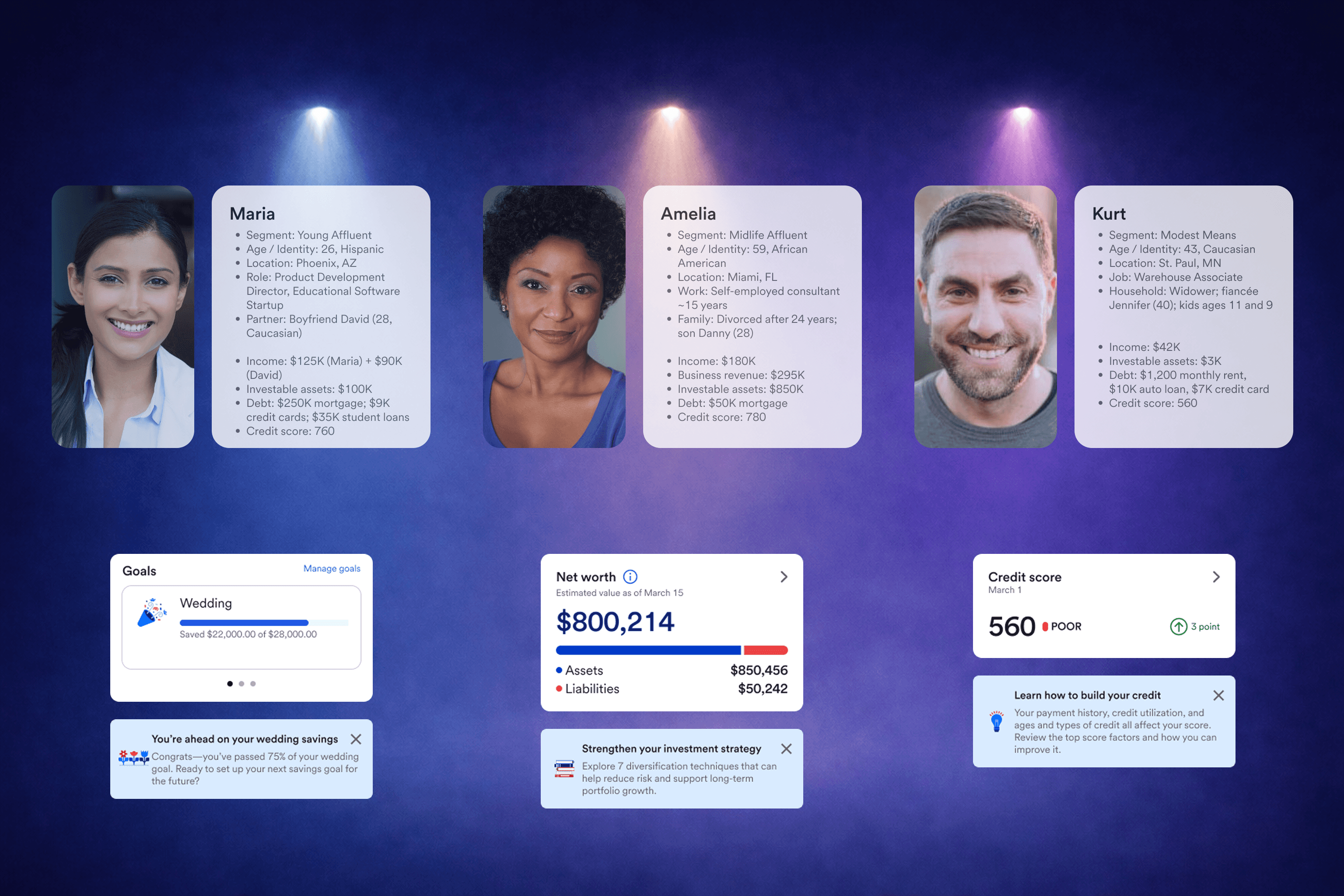
A blue-to-purple gradient scene with spotlight beams illuminating three persona cards—Maria, Amelia, and Kurt—each with a portrait and demographic/financial details, with supporting app UI cards below showing a wedding goal with progress message, a net worth summary with an investing tip, and a credit score (560, poor) with a “learn how to build your credit” prompt.

Learning how different people think about money

We combined multiple research methods:

  • Heuristic and competitive analysis to identify gaps

  • In-depth user interviews with UX Research partners

  • Journey mapping to visualize life moments and emotional needs

  • Usability testing across segments to validate personalization hypotheses

Personal motivation and life stage drive financial behavior

Key insights included:

  • Users manage finances around four goals: spending, saving, investing, credit

  • Motivations vary widely — buying a home, growing wealth, preparing for retirement

  • Engagement correlates strongly with top-of-mind goals

  • Users expect contextual guidance because U.S. Bank already holds their data

  • Tone must adapt by segment — what reassures one group overwhelms another

Personalization emerged as the foundation of trust.
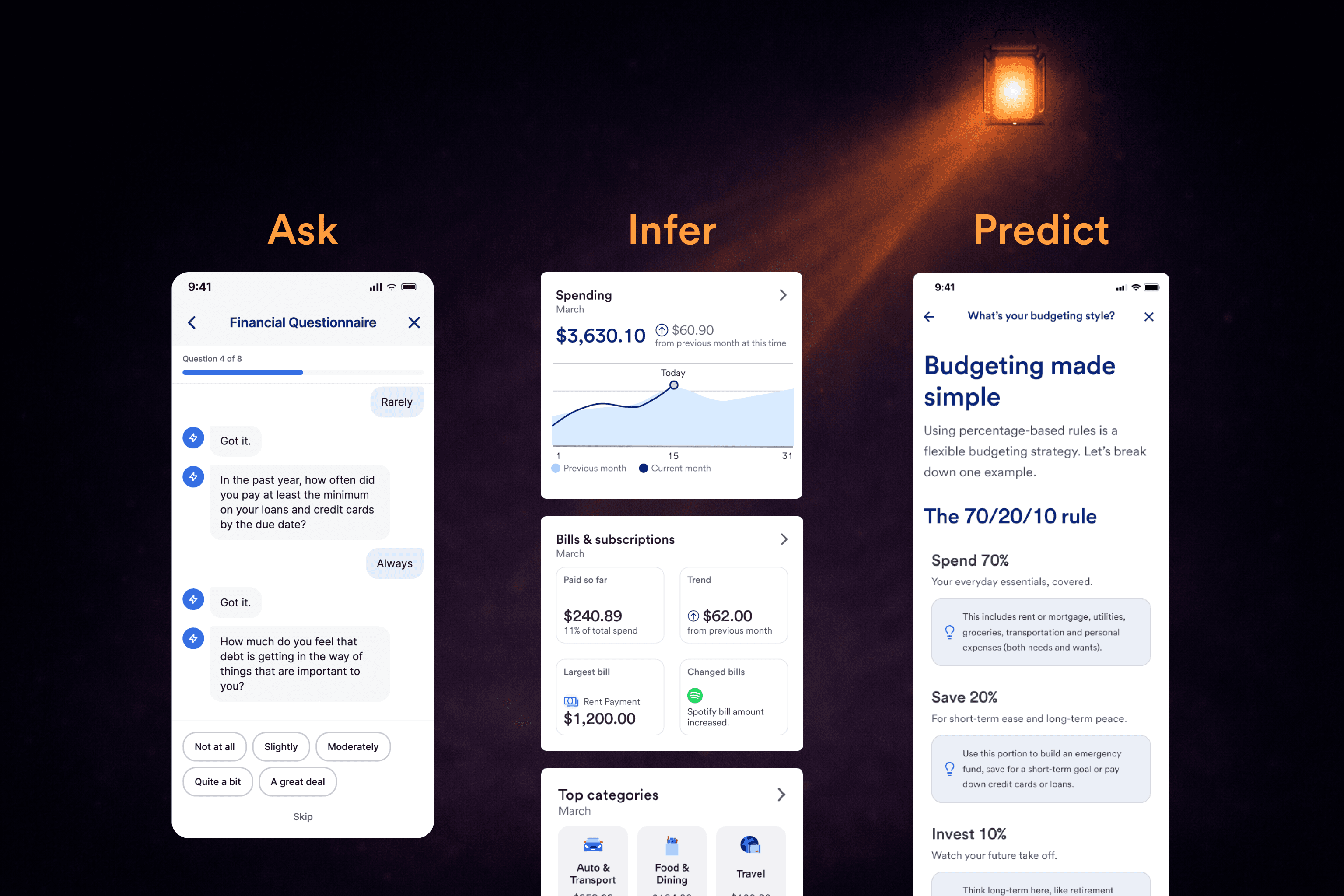
A dark purple gradient scene with a glowing lantern in the upper right casting warm light over three columns labeled “Ask,” “Infer,” and “Predict.” The “Ask” column shows a mobile financial questionnaire chat; “Infer” shows spending, bills, and top-category summary cards; and “Predict” shows a budgeting education screen explaining the 70/20/10 rule.

Defining a personalization strategy grounded in user intent

We established three guiding principles:

  1. Personalize with purpose — tailor experiences using known data

  2. Balance now and next — connect daily actions to long-term goals

  3. Adapt to context — vary content by life moment and confidence level

Designing journeys that connect goals, tools, and motivation

I led journey mapping and gap analysis to identify where continuity was missing.

We created a segment-based tool hierarchy and designed goal-driven use cases, such as:

  • Buying a house → recommend Round-Up savings + credit monitoring

  • Growing wealth → highlight investment tools + progress tracking

We then wireframed the experience and aligned closely with UX Research, Product, and Development to refine flows and plan additional testing.

Through multiple design iterations, we validated concepts and moved toward final creative execution.

To support scalability, I created Plan & Track design guidelines — including product objectives and technical design specs — enabling other teams to build consistent modules across Native and React platforms.

Delivering measurable impact and long-term value

  • +30% improvement in feature discoverability

  • 75% “helpful” satisfaction score, exceeding internal benchmarks

  • Research directly informed the 2025–2026 roadmap

  • Partnered with Engineering to build the foundation for scalable personalization across U.S. Bank